A food lover's guide to the Johnston Street Fiesta in Fitzroy: tapas, empanadas, arepas, tacos and churros explained, where to shop, and arepas to cook at home.
Every summer, Johnston Street in Fitzroy shuts to traffic between Nicholson and Brunswick streets and turns into the biggest Hispanic and Latin American party in the country. The Johnston Street Fiesta has been running for more than four decades. The 2026 edition was its 48th year, and the 2027 date is , with recent fiestas held over a weekend in late February. Expect salsa bands, dancers, craft stalls and, best of all, a long line of grills, paella pans and fryers.
This guide is about the food: what the dishes are, which ones to queue for, where to shop on Johnston Street the rest of the year, and how to make arepas at home.
The Johnston Street Fiesta and Fitzroy's Spanish precinct
Johnston Street has been the centre of Melbourne's Spanish-speaking community for decades, and Yarra Council still calls this stretch the Spanish precinct. The fiesta is produced by the Hispanic-Latin American Festival and Cultural Association, with the council as its major sponsor, and it brings together Spanish, Mexican, Colombian, Chilean, Salvadoran, Argentinian and many other communities on the one street. The program has live bands and dance across the weekend, and in past years a street parade on the Sunday.
The easiest way there is by tram: route 96 along Nicholson Street or route 11 along Brunswick Street both drop you at either end. Buses don't run through the closed section, so leave the car at home.
Spanish tapas
Tapas are small plates meant for sharing with a drink, which makes them perfect festival food. Patatas bravas are fried potato chunks with a smoky paprika tomato sauce and often a garlicky aioli. Gambas al ajillo are prawns sizzled in olive oil with lots of garlic and chilli; mop up the oil with bread, it's the best bit. Tortilla española is a thick omelette of potato and onion cooked slowly in olive oil, served in wedges at room temperature. And croquetas are crumbed, fried fingers of creamy béchamel with ham or salt cod through them.
Then there's paella, cooked in huge shallow pans you can smell from half a block away. Good paella has a thin layer of rice, never stirred once the stock goes in, and a crisp toasted crust on the bottom called socarrat. Ask for a scoop from the edge of the pan where the crust is best.
Empanadas, arepas and tacos
Empanadas are hand pies, and every country does them a bit differently. Argentinian empanadas are usually baked, with a pleated edge and fillings like spiced beef with olive and egg. Chilean ones are bigger and often baked too, while Colombian empanadas are made with corn dough and deep-fried until crunchy, served with a sharp green ají sauce.
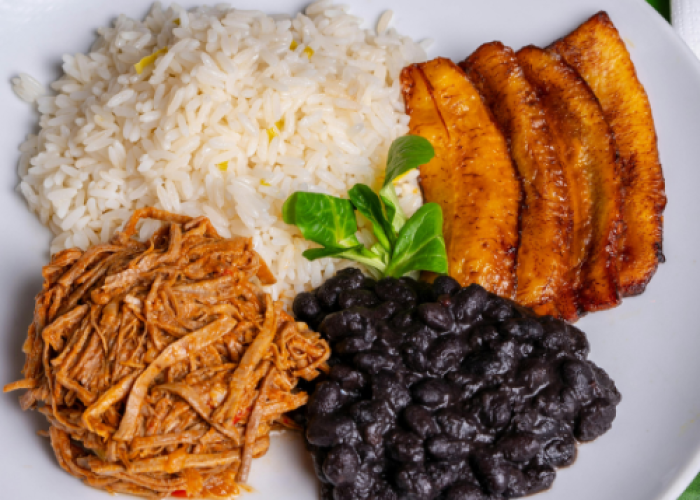
Arepas are round corn cakes from Venezuela and Colombia, cooked on a griddle until crusty outside and soft and steamy inside. Venezuelans split them open and stuff them like a pocket. Try one with shredded beef, black beans and white cheese, or a reina pepiada, filled with chicken and avocado.
Mexican tacos at a fiesta should come on small, soft corn tortillas, often doubled up so they don't split. Tacos al pastor (marinated pork with pineapple) and carnitas (slow-cooked pork crisped at the end) are the classics. Keep the toppings simple: onion, coriander, a squeeze of lime and salsa. While you're near the Salvadoran stalls, look for pupusas, thick corn cakes stuffed with cheese, beans or pork and served with a tangy cabbage slaw called curtido.
Churros and something sweet
Finish with churros, ridged sticks of fried dough rolled in cinnamon sugar. In Spain they're dipped in thick hot chocolate, and in Latin America they're often filled with dulce de leche, a caramel made by slowly cooking milk and sugar. Eat them straight out of the fryer. A churro that's been sitting for twenty minutes is a very different thing.
We went to visit this festival often each year. I draw many people from multicultural communities and local come out to visit. Great dance and food and plenty of vibes.
Where to shop on Johnston Street
You don't have to wait for the fiesta. Casa Iberica, at 25 Johnston Street, has been in the precinct since 1975 and is a one-stop shop for Spanish and Latin American cooking. It stocks masa flour for tortillas, chorizo, dried salt cod, Colombian guava paste, Salvadoran plantain chips, Mexican hot sauces, tortilla presses and paella pans, and the deli counter makes jamón and cheese sandwiches. They're also known for their Portuguese custard tarts, which sell out early.
One thing to know before you buy corn flour: Mexican masa harina and the precooked corn flour used for arepas (often sold as masarepa) are not the same. Masa harina is made from corn treated with lime, and it's what you want for tortillas and tamales. Arepa flour is precooked and makes a softer, smoother dough. Swap them and neither recipe works properly.
Make arepas at home
Arepas are one of the easiest Latin dishes to cook at home, and they're naturally gluten-free. For about eight:
- 2 cups precooked white corn flour (masarepa)
- 2½ cups warm water
- 1 tsp salt
- Fillings: black beans, avocado, crumbled white cheese, shredded beef or chicken
Stir the salt into the warm water, then pour in the flour gradually while mixing with your hand. Let the dough sit for five minutes to hydrate. It should feel like soft play-dough; add a splash of water if it cracks at the edges. Roll into balls, then flatten into discs about 1.5 cm thick and smooth any cracks with a wet finger.
Cook in a lightly oiled heavy frying pan over medium heat for five to six minutes each side until there's a golden crust and they sound hollow when tapped. Split them while hot with a small knife, leaving one side attached like a pita, and stuff generously. Serve with a quick pico de gallo of diced tomato, onion, coriander, chilli and lime juice, and you've got a fiesta at your table.
Visit Johnston Street with Otao Kitchen
We can organise a visit to Johnston Street for your group as part of a cooking experience at Otao Kitchen. To keep things comfortable for shoppers and fair to the traders, each visit is capped at 20 people. Larger groups are very welcome: we run rolling visits, so no more than 20 of your group are there at a time.
See our Melbourne Market Cooking Experience →
Cook Latin American food with us
Our Flavours of Latin America class covers the corn doughs, salsas and slow-cooked fillings behind this kind of street food. If you've got a favourite country, we also run a Mexican Cooking Masterclass and a Spanish Cooking Masterclass. Each one is three hours, hands-on, and ends with sitting down together to eat what you've cooked.